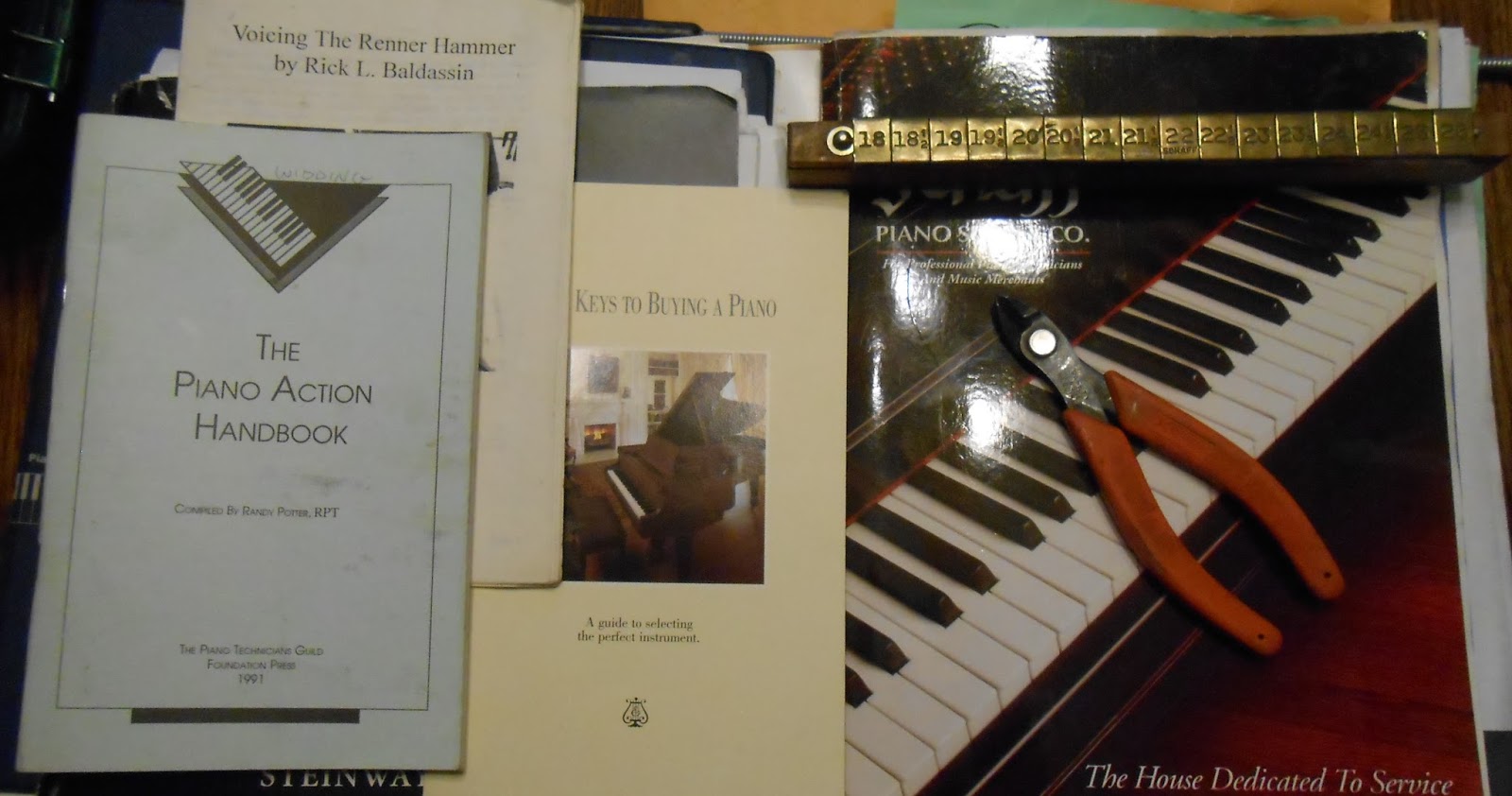
The key bushing tightener
In the hands of a tech who knows
how and when to use it, such can work miracles. In the hands of a novice, it can ruin keysticks. It is not meant for wood crushing*; instead, with a light tap to move glued felt in toward the front rail pin to eliminate too much side motion. If this does not do the job, then the keys need to be rebushed with the proper size bushing cloth.
Never should the front rail pins be turned by a tech in the field to eliminate too much side motion! Why not?
Keysticks are not cut, routed and bushed perfectly at the factory. Therefore, the front rail pins are set to allow for even alightment via turning. The rectangular or oval front rail
pins afford adequate surface-to-bushing area to stabilize
evenly the key during
performance.
Since the pins are turned into keybed,
and in time, expansion and contraction of wood in tandem with vibration
from playing the instrument ensues, pins can (and do) move. The shape of
the pin provides an easy way for the tech to turn to the proper position during a
regulation with the correct tool.. Wouldn't do so
well with a round pin. A flat pin - especially one that's moved -
would catch on the bushing.
In virtually all regulations - both
uprights and grands - varying numbers of front rail pins have moved - in
my experience. The tech can turn the pins to factory specs. If these become loose, then repair is effected. However, if the tech turns the pins to compensate for too much side-to-side play,
the "corners" thereof
will wear the bushings away more quickly. Moreover, some pianists have
complained that a turned pin creates a rather odd imbalance to the feel
or touch. (I concur.) With newer oval
plated and polished pins the result may not be quite as bad, however,
when turned even these will create enough reduced surface area - in
effect, "corners" - that will wear the bushing away faster. Best to bush with correct size cloth and not
turn pins to eliminate side-play.
As Ed (RPT) points out: "When the pin is turned, say 10
degrees clockwise, the surface area that touches the felt is reduced
since the right side of the felt is only in contact with the rear face
of the oblong pin, and the left side is only touching the forward face.
This is simple geometry. The wear increases..."
I wholehearted;y agree. The larger issue is the imbalance created by the change in where the pin is contacting the bushing after the pin turn. Many piano players may not notice a change in feel or touch. Some of the really fine pianist might (and have).
A variety of common front rail pins: Various photographic angles.


 Piano Service 101
"The front rail pins are
shorter and oval in cross section, and extend
only part way up into the front ends of the
keys...
"Never turn a front rail pin to take up side
play in the bushing. If you turn it, the corner
will wear the bushing away even faster,
aggravating the condition. If the bushing is
bad, replace it."
Reblitz, pp 34, 120. 1993 ed.
*I have seen wood crushed by this tool to such an extent that the wood has fallen out!